-
Welcome to the Roth IRA Conversion Optimizer Blog
The latest posts are below. Feel free to respond to any of the posts with comments, questions or suggestions.
-
Even the Most Aggressive Route—Converting the Entire IRA in a Single Year—Outperforms Doing Nothing

When couples reach age 80, Roth conversion planning often feels overwhelming. Many decide to “do nothing” simply because it seems easier. No big tax bill, no paperwork, no disruption. Just let the IRA grow and deal with it later. But for an 80‑year‑old married couple with a 10‑year planning horizon, doing nothing is actually the…
-
The Hidden Power of Sensitivity Analysis in Roth IRA Conversion Planning
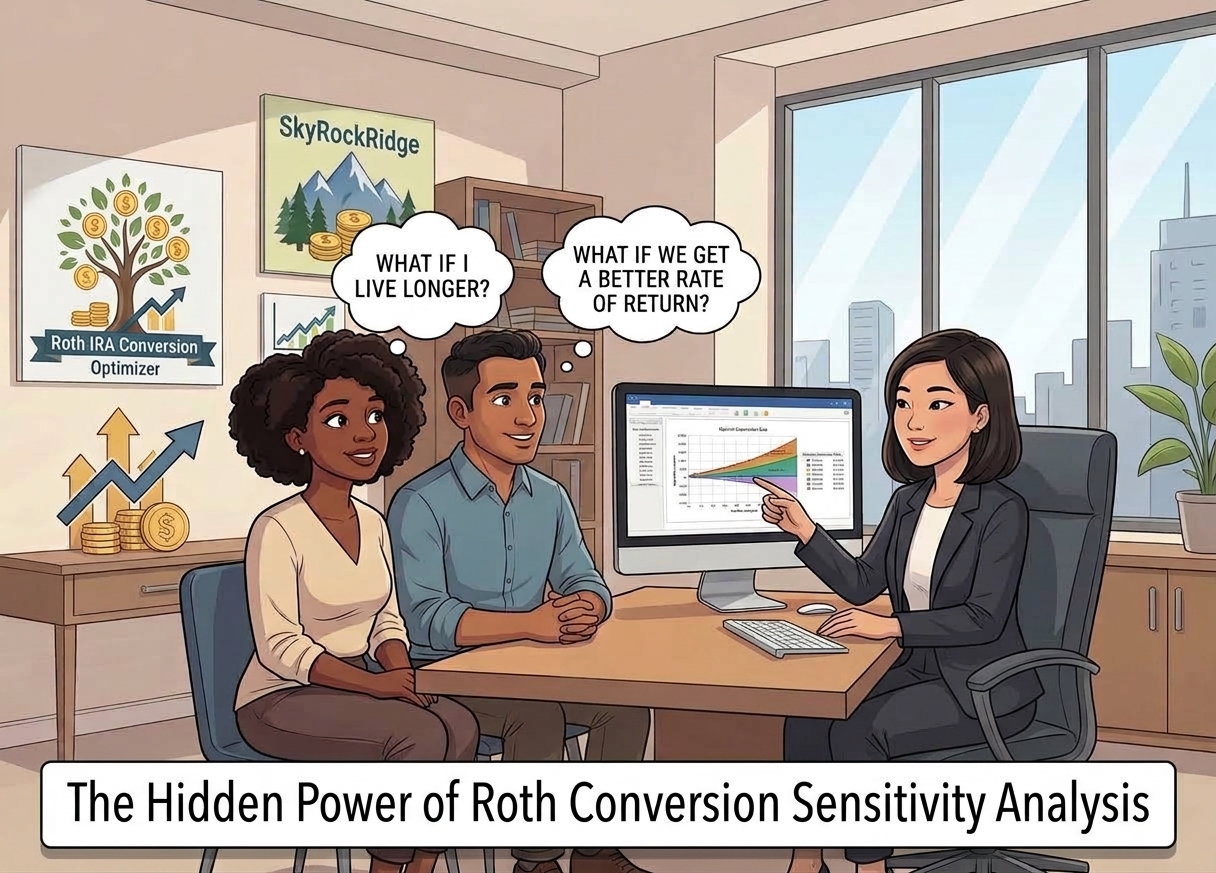
Why Time Horizon and Rate of Return Drive Asymmetric Payoffs — And Why Most Tools Miss It When advisors talk about Roth IRA conversions, the conversation usually centers on tax brackets, RMD suppression, and long‑term compounding. But beneath all of that lies a deeper, more powerful truth: Roth conversion strategies are highly sensitive to two…
-
Converting a $3 Million IRA All at Once Can be Just as Good as Spreading it Out

A high‑net‑worth client recently asked their advisor a straightforward question: “I have a $3 million IRA and plenty of non‑retirement assets to pay the tax. Should I convert all of it this year, or spread it out?” Explaining multi-year tax dynamics verbally or using basic static charts is notoriously difficult. Without a dedicated multi-year engine…
-
The Hidden Tax Forces That Reshape Roth Conversion Strategy: A Five‑Scenario HNW Client Case Study for Advisors

Financial advisors know that Roth conversions can add millions to a client’s lifetime after‑tax wealth — but only when modeled correctly. Most calculators stop at simple bracket‑fill rules or single‑scenario projections. The Roth IRA Conversion Optimizer takes a different approach: it models all the key tax forces that shape lifetime wealth, including the widow tax,…
-
The $10M Asymmetry: Why Conversions for HNW Clients Require Upside Stress-Testing
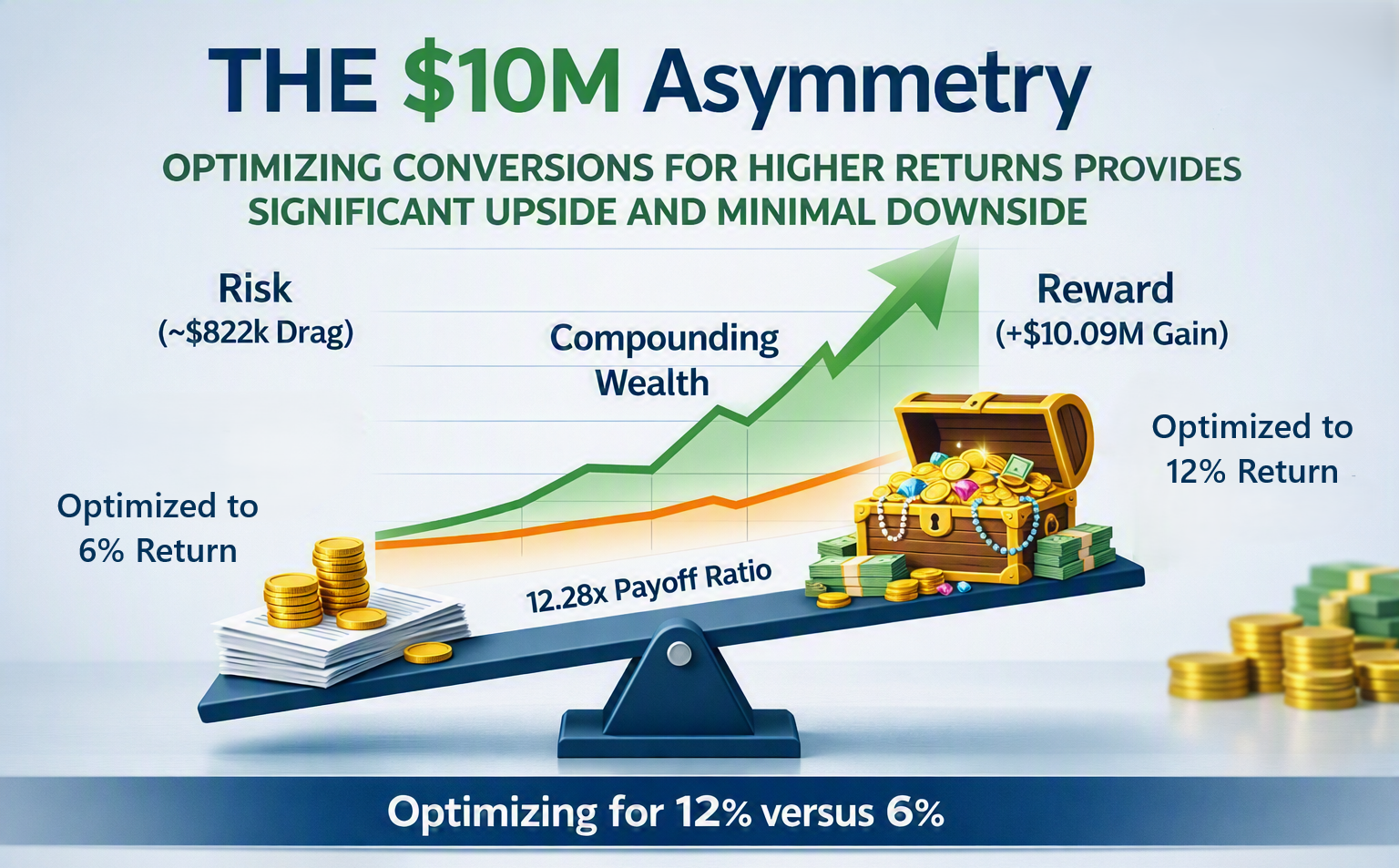
For wealthy clients, the biggest risk isn’t running out of money — it’s failing to plan for above‑average returns, and accidentally creating a tax time‑bomb that compounds for decades. When financial planners build a retirement roadmap, the golden rule of fiduciary responsibility is conservatism. Baseline plans are universally modeled around 5% to 7% long-term portfolio…
-
A Longer Roth Conversion Horizon Provides Minimal Downside with Significant Upside
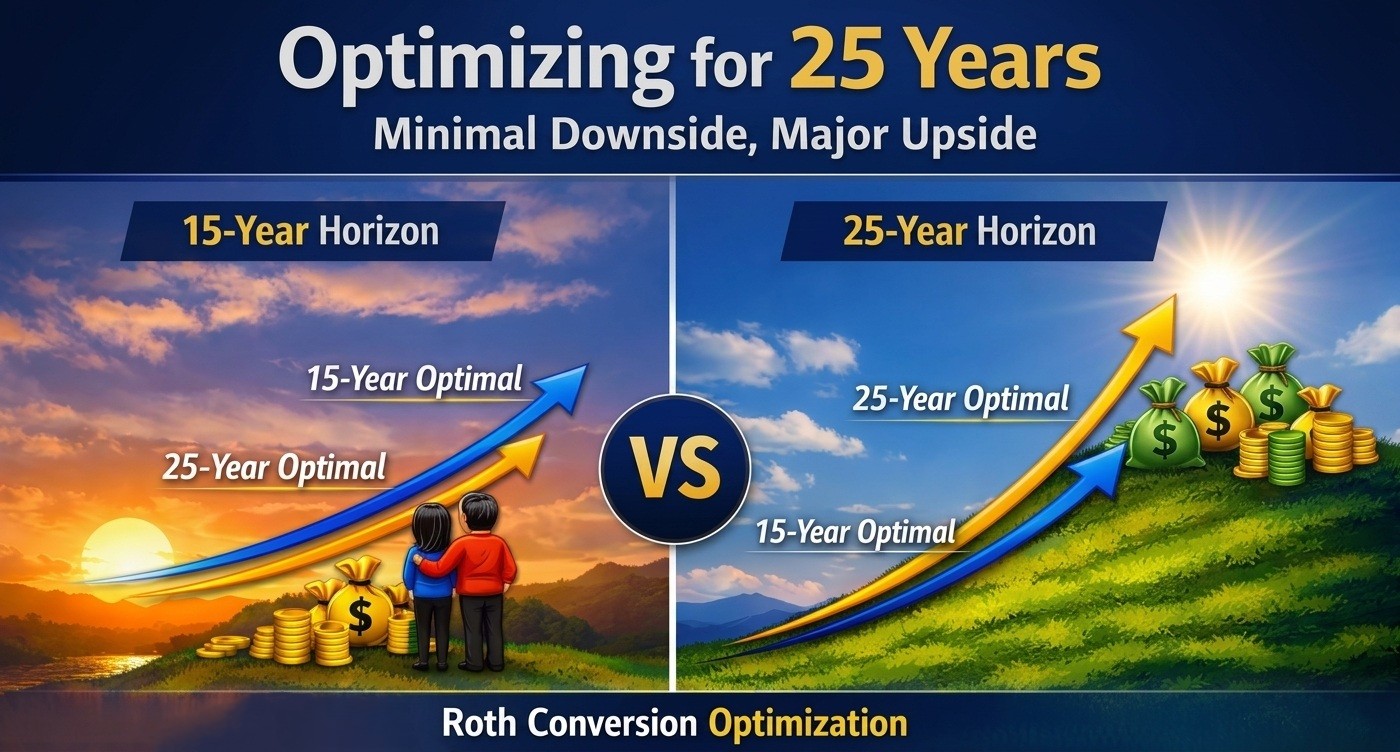
High‑net‑worth clients often ask a simple question: “How far out should we project when planning Roth conversions?” Most advisors default to a 20–30 year horizon, but many clients think in shorter windows — 10 to 15 years. To answer this question, we modeled the same MFJ couple from our previous case study under two different…
-
Runaway IRA—The Black Hole of Retirement Planning
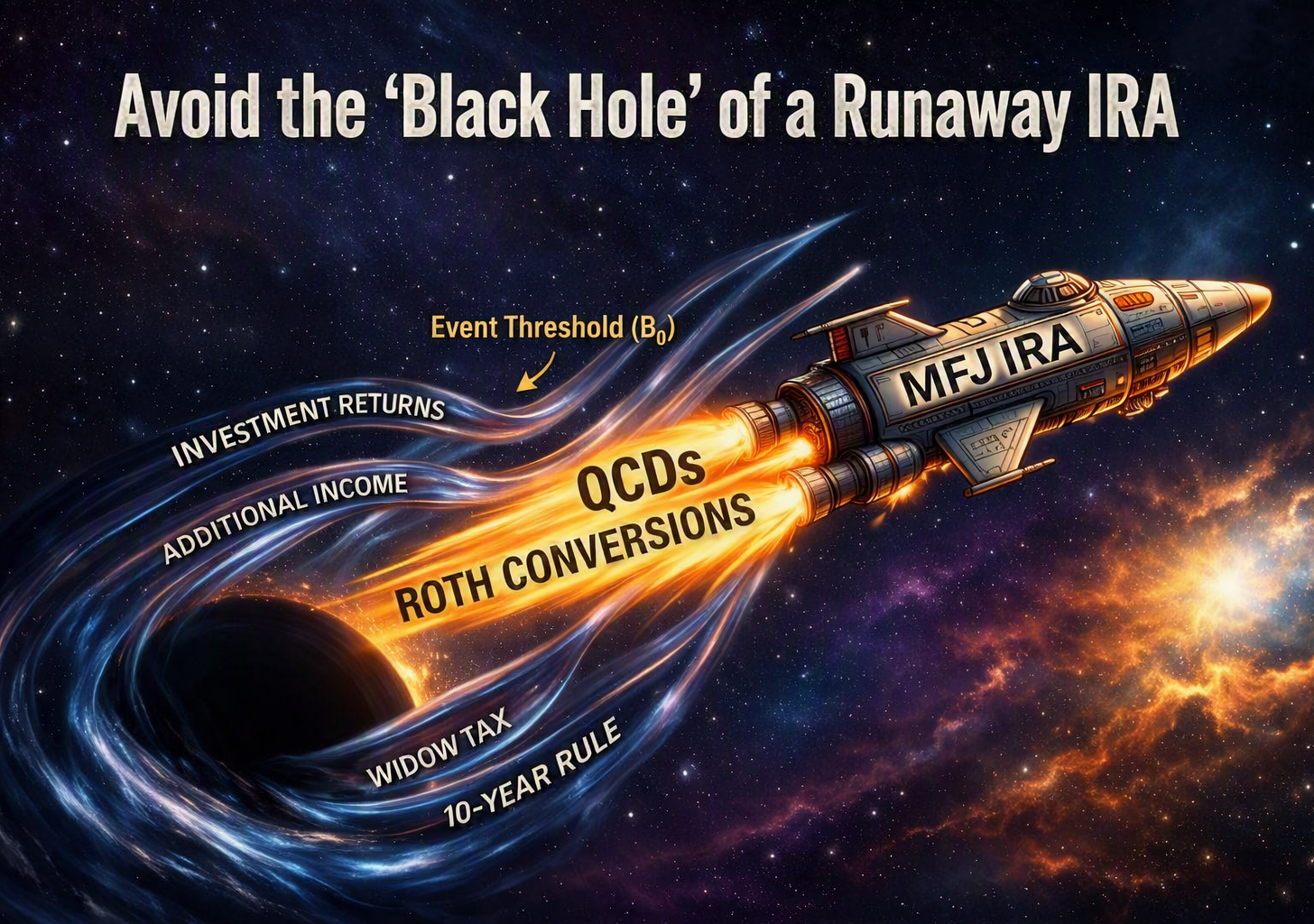
In traditional retirement planning, building a multi-million-dollar pre-tax IRA is universally celebrated as the ultimate mark of financial success. Investors spend decades maxing out 401(k)s and Traditional IRAs, harvesting pre-tax deductions, and letting compound growth work its magic. However, under progressive federal tax structures, an unchecked pre-tax portfolio harbors a critical, structural hazard. There exists…
-
Roth Tax Bracket Filling: How Much Money Are You Leaving on the Table?

Most financial advisors and DIY investors intuitively know that bracket filling isn’t the optimal strategy for Roth conversions, but until now, there hasn’t been a clear way to quantify it. Version 4.5 of the Roth IRA Conversion Optimizer is a significant new release. It can tell you exactly what the difference is. The Optimizer now…
-
Widow Penalty — Plan For The Most Overlooked Tax Trap

When couples plan their retirement taxes, almost every projection assumes one thing that is never true in real life: That both spouses will live the same number of years. This single assumption hides one of the largest tax traps in retirement planning — the Widow Penalty (also called the Widow Tax). Roth conversion tools, calculators,…
-
Stop Guessing Your Future Tax Rate: Why Roth Conversion Calculators Get It Wrong
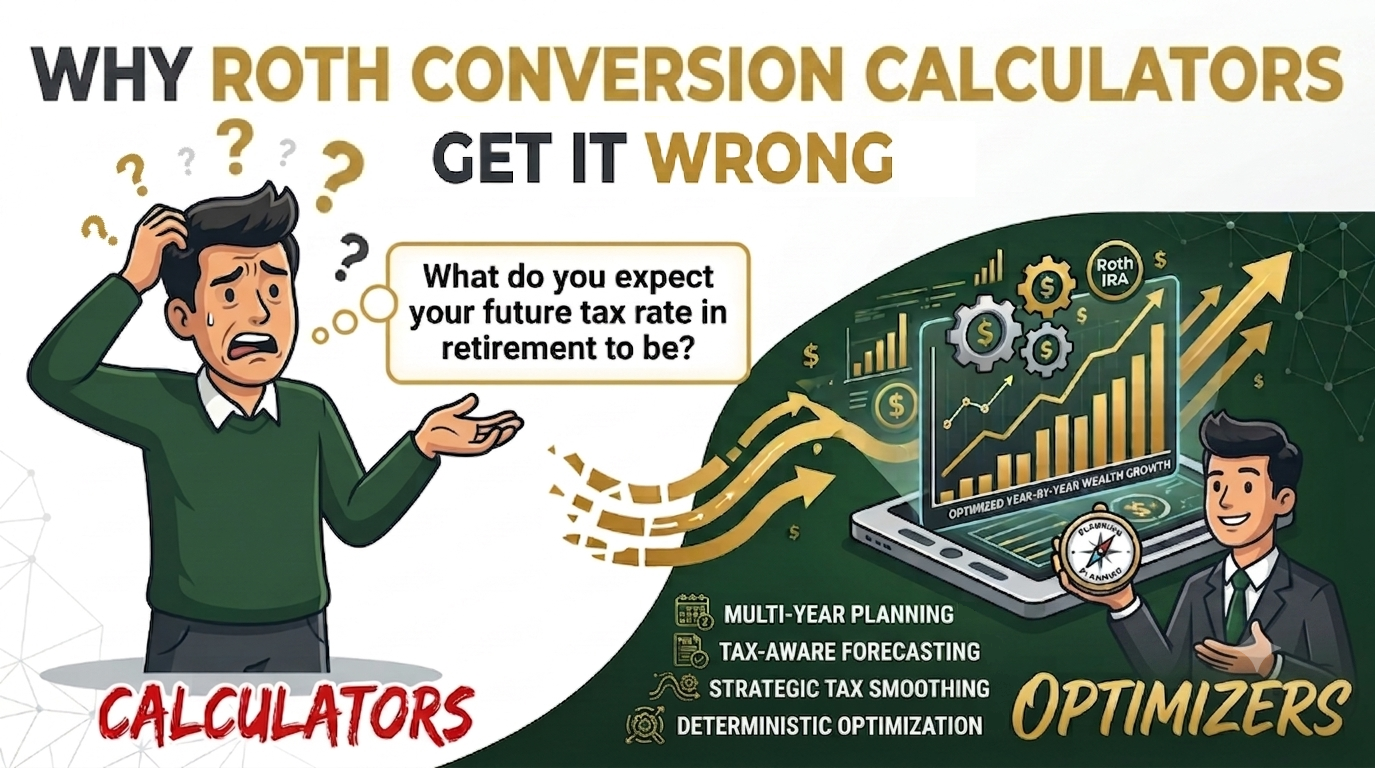
Most Roth conversion calculators share one fatal flaw: they ask you to estimate your future tax rate in retirement. If you’ve ever used one, you’ve seen the prompt: “What do you expect your tax rate to be in retirement?” This single question undermines the entire calculation. If you already knew your future tax rate, you…
-
User-Editable Blue Columns
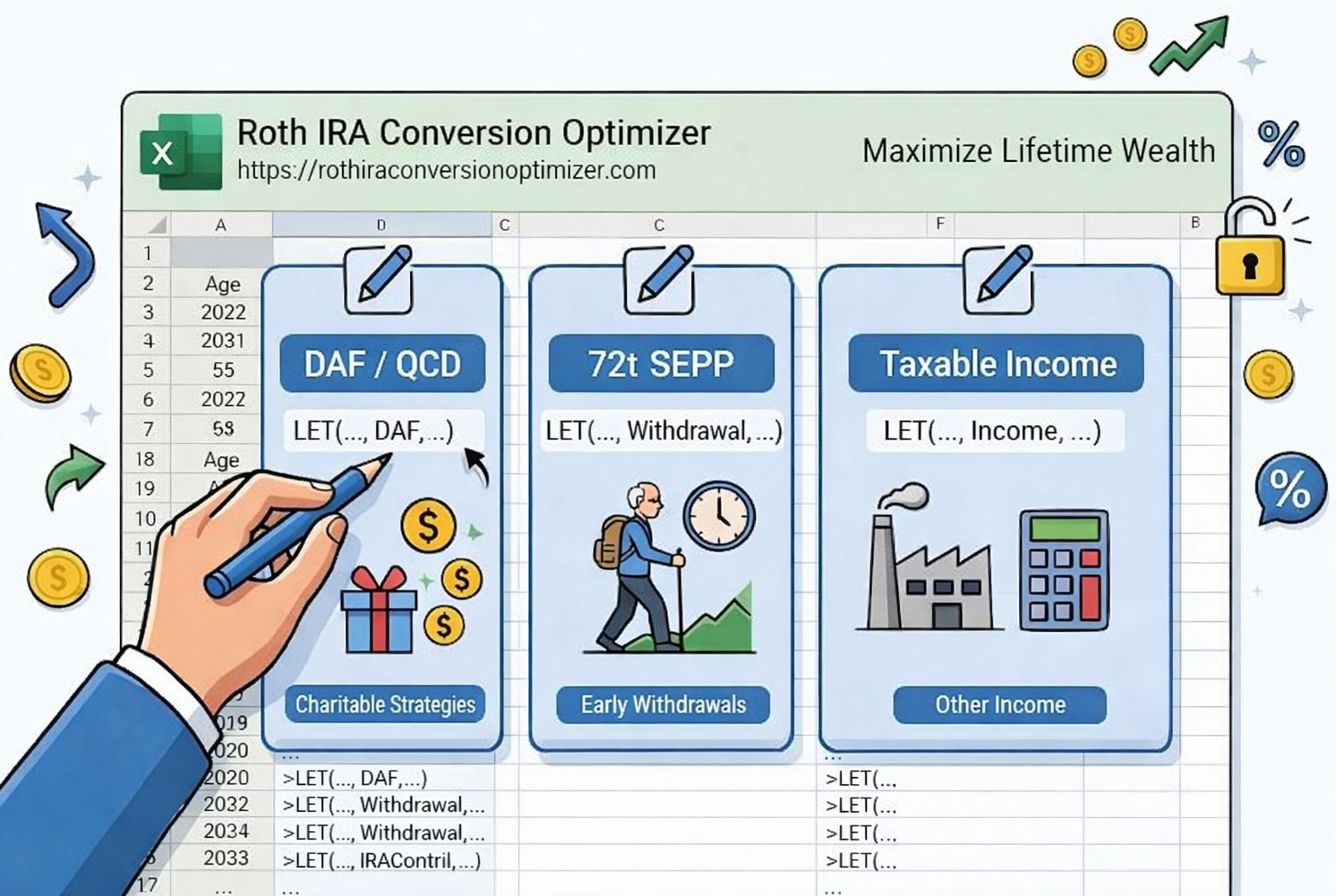
The Roth IRA Conversion Optimizer has four blue columns on the Main worksheet and four blue columns on the MFJ Detail worksheet. These are the only cells you can edit on these sheets without unlocking the spreadsheet, and each one contains example formulas that can be customized to fit their specific needs. Are your blue-column…
-
New Feature: Help Icons Now Built Directly Into the Optimizer
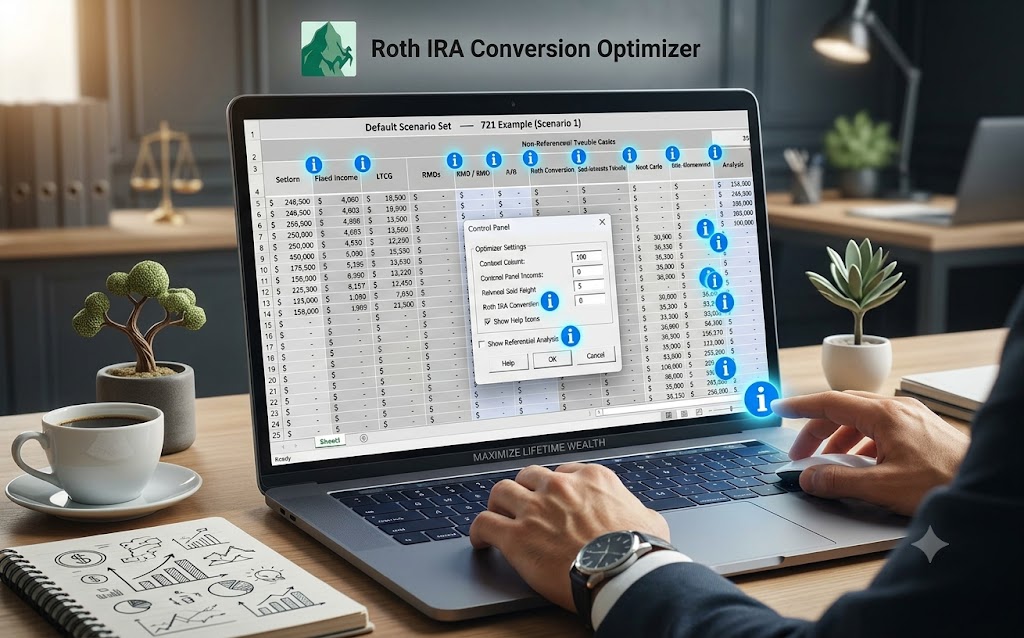
A smoother, more intuitive experience just landed in the Roth IRA Conversion Optimizer. We’ve added a new Help Icons feature throughout the worksheets and Control Panel—designed to give you instant, context‑specific guidance right when you need it. Whether you’re reviewing inputs, adjusting scenarios, or exploring Monte Carlo results, these icons make it easier than ever…
-
The Hidden Retirement Error: Leaving “Free” Roth Space on the Table

When discussing tax-smoothing strategies, the industry focus almost immediately turns to Roth conversions. It’s a powerful lever—evaluating how to efficiently fill low tax brackets by shifting assets from Traditional IRAs to Roth IRAs. However, in the rush to optimize conversions, a foundational, highly cost-effective step can sometimes be skipped. If you earn any income in…
-
Introducing QCD & DAF Support in the Roth IRA Conversion Optimizer
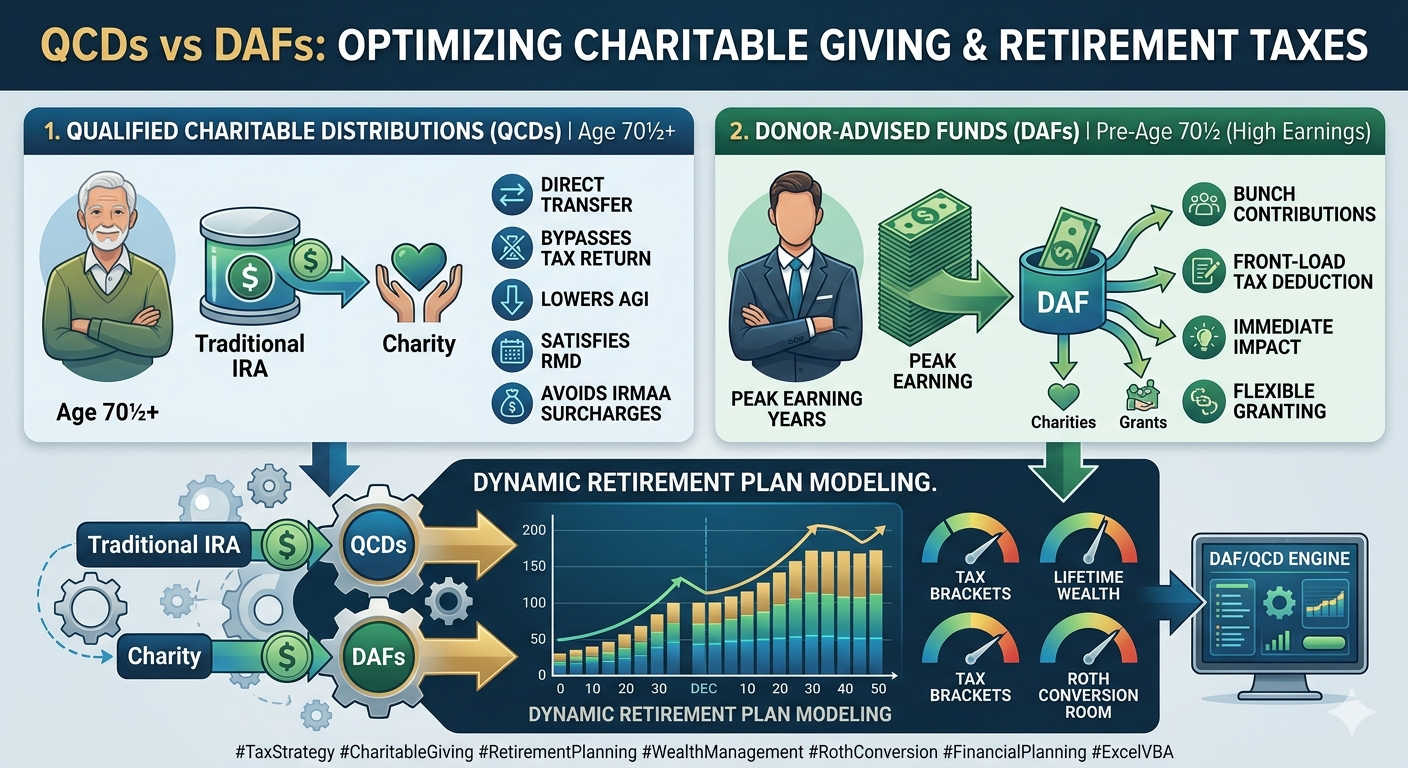
A smarter way to model charitable giving inside long‑term tax planning Charitable giving has always played a meaningful role in retirement planning, but until now, most planning tools treated it as an afterthought—or ignored it entirely. With a recent update to the Roth IRA Conversion Optimizer, that changes in a big way. Your Optimizer now…
-
Marginal Tax Rate and Future-Year Tax Bracket Lookup
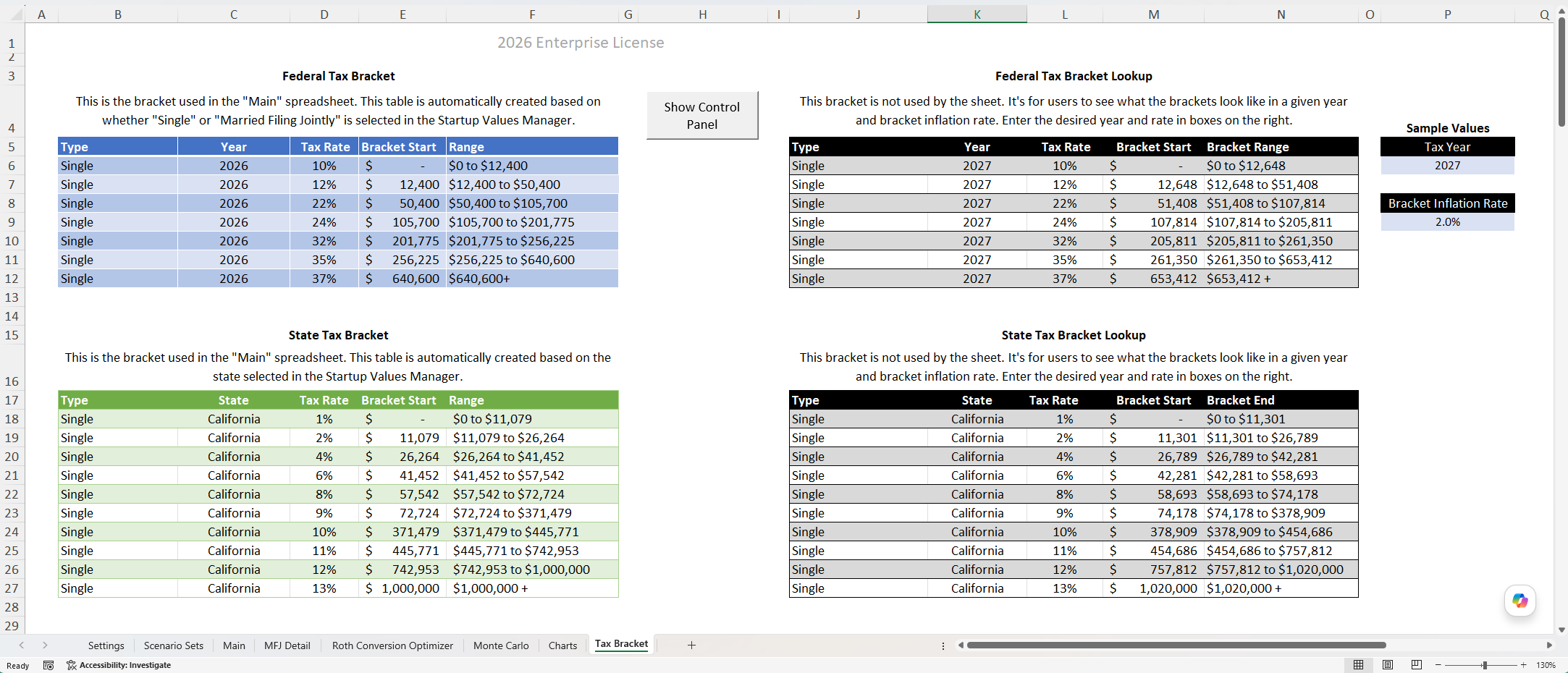
Tax bracket modeling is a cornerstone of tax-aware retirement planning. Two powerful existing features set the foundation: Building on these, we’re excited to introduce some new features that gives you more insight into your future tax situation. To look up a future bracket, you simply enter the Tax Year and Bracket Inflation Rate into the…
-
New Research: How Roth Conversions and Tax Smoothing Maximize After-Tax Net Worth
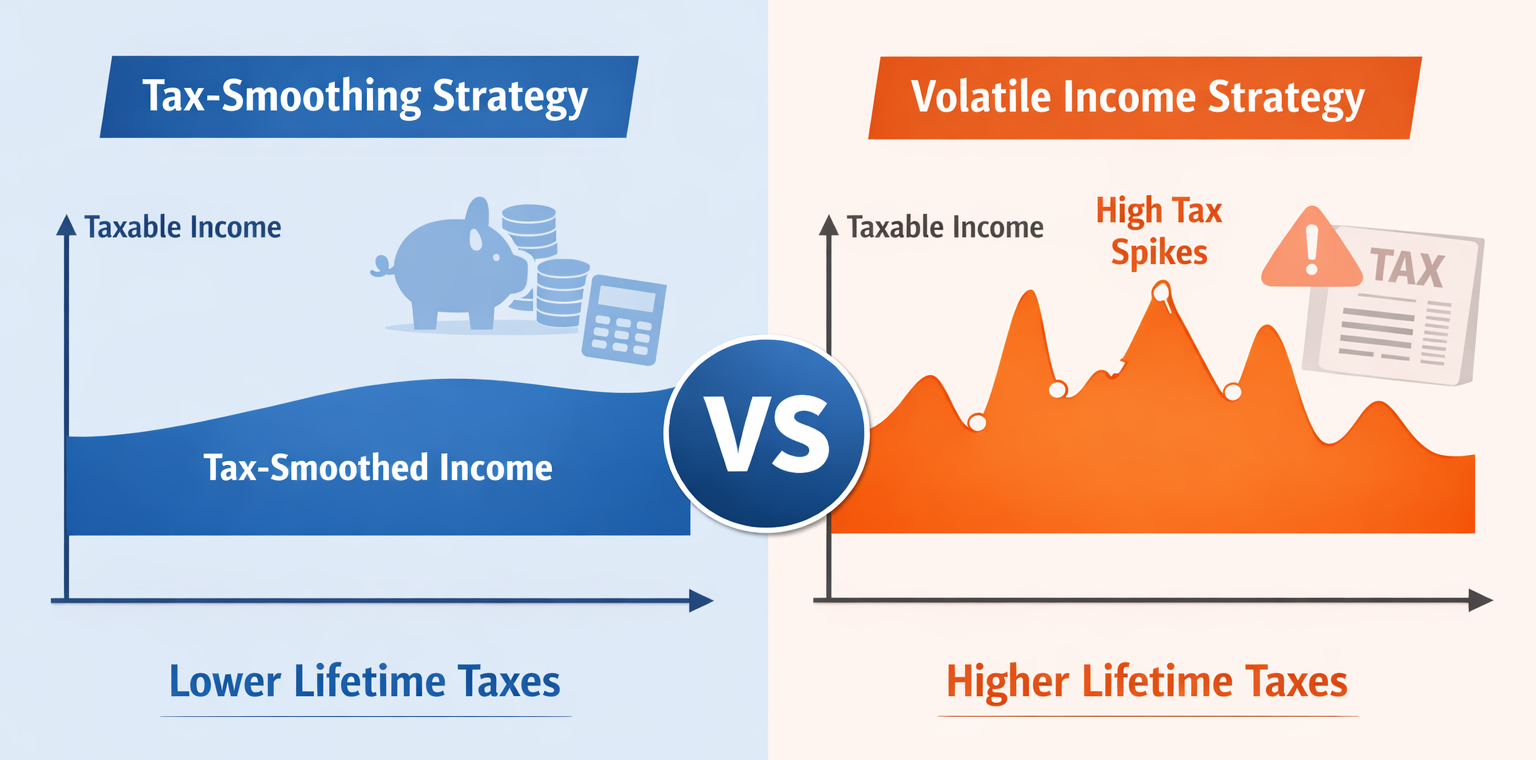
Most retirement tax strategies focus on what to do this year. But the real opportunity lies in managing taxes across your entire lifetime — and that’s exactly what our new white paper explores. The paper, “Tax Smoothing: A Roth Conversion Framework for Maximizing After Tax Net Worth,” breaks down the research behind the Roth IRA…
-
What if Social Security is Reduced? Stress Test Your Roth IRA Conversion Plan
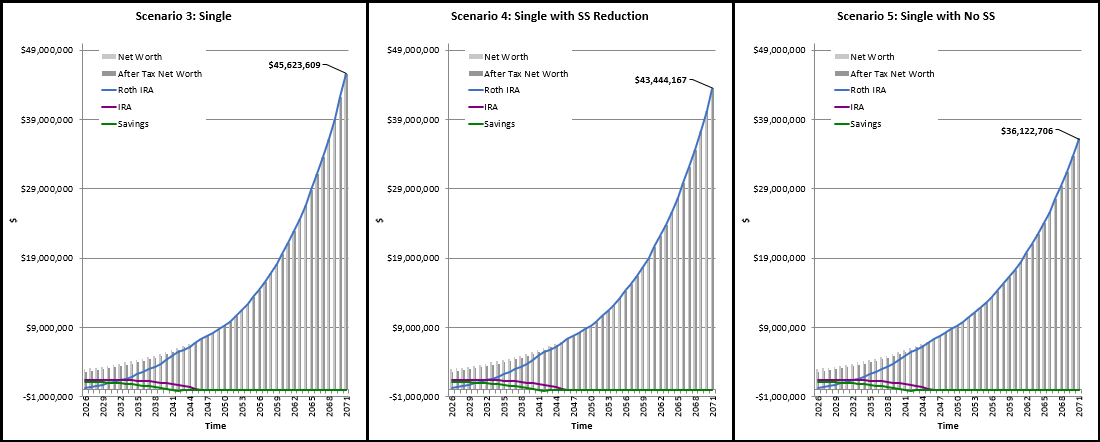
One of the most common questions users ask is: “What happens to my plan if Social Security is reduced in the future?” The Roth IRA Conversion Optimizer has a built-in feature for modeling different Social Security reduction scenarios. 🎯 What This Feature Does In the Experimental Settings section, You can specify: This allows you to…
-
The Tabbed Control Panel Is Here!

Navigating the Roth IRA Conversion Optimizer shouldn’t feel like a chore. Today I’m excited to introduce version 4.2 with a major usability upgrade: the new Tabbed Control Panel. This redesign makes navigation faster, cleaner, and more intuitive. Instead of one long panel with dozens of buttons, the interface is now organized into four focused tabs,…
-
Hidden Worksheets
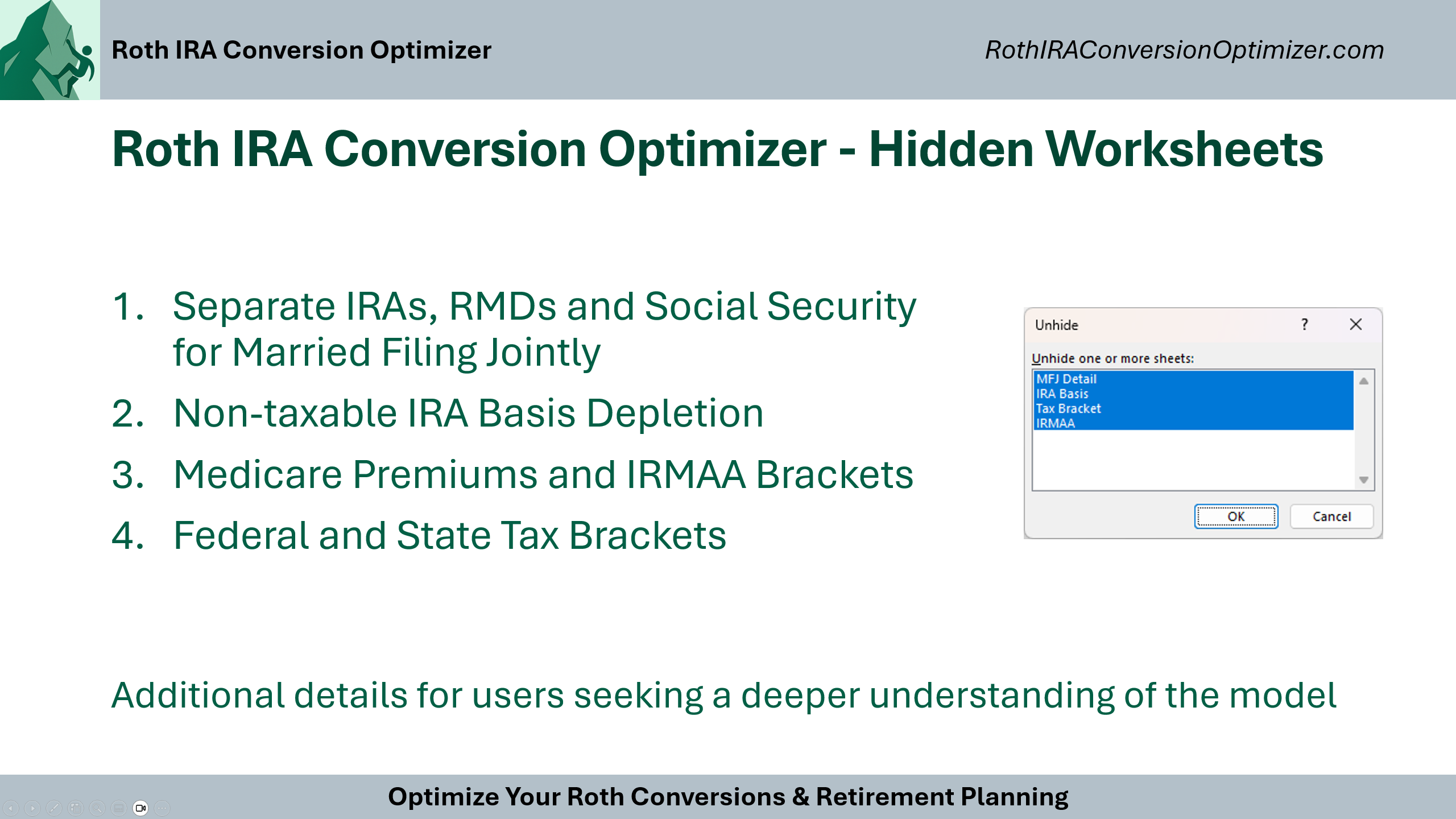
The main interface of the Roth IRA Conversion Optimizer is intentionally clean and approachable. Users will spend most of their time setting up Scenarios on the Scenario Set worksheet and viewing the results on the Main worksheet. Beneath that simplicity lies a sophisticated, tax-aware engine that calculates: For users who want to see this additional…

SkyRockRidge
Roth IRA Conversion Optimizer

The Roth IRA Conversion Optimizer is an advanced Excel calculator built to maximize your lifetime wealth by identifying the optimal Roth conversions for a specific scenario and allowing you to see the impact of input parameters on these conversions. Each scenario represents a multi-year retirement model based on a distinct set of user-defined assumptions. Because Roth conversion strategy is highly sensitive to variables such as inflation rates, tax bracket indexing, market returns, and planning horizons, the Optimizer functions as an interactive decision-support engine to stress-test these factors ensuring that any final conversion strategy is informed by thorough scenario analysis. The Personal version also enables users to run Monte Carlo simulations to analyze risk associated with market volatility.
To ensure the most accurate results, the Optimizer provides support for the following: federal taxes, state taxes, federal estate tax, state estate tax, heir tax on inherited IRA, IRD deduction, LTCG taxes, Social Security tax torpedo, NIIT, IRMAA, widow tax penalty, 72T, QCDs, MFJ/HoH/Single filing status, IRA basis, adjustable inflation, adjustable bracket inflation, and much more. While the default settings will be sufficient for most people, there is significant flexibility for those who need it.
Most Roth optimizers and calculators are simplified, “black-box” models that use a “fill-up-your-bracket” approach to minimize taxes—which is rarely optimal. Unlike those tools, this Optimizer is a highly configurable, tax-aware forecasting engine that combines strategic tax smoothing with a deterministic search. Built entirely in Excel with visible formulas, it provides a transparent, year-by-year breakdown of your projected account values, income, expenses, taxes, and net worth for each scenario. See the white paper and methodology links below for more details.
- Tax Smoothing: A Roth Conversion Framework for Maximizing After Tax Net Worth
- Roth IRA Optimization Methodology
This is the public site for the Optimizer Knowledge Base, Blog, Product Listing, and Advisor Partner Program. SkyRockRidge.etsy.com is the official Optimizer storefront.

Both personal use and commercial versions are available (see the Product listing). A free 5-day evaluation copy is also available for firms and advisors to test the model before purchasing. Contact me directly to request your free download.
Not Financial Advice: This tool is provided for informational and educational purposes only and does not constitute financial, investment, or tax advice. Please consult a licensed professional for personalized guidance.
No Guarantees: While every effort has been made to ensure accuracy, we make no guarantees regarding outcomes or results. Use of this tool is at your own discretion and risk.